
Recently, German Philology students from the University of Applied Sciences in Racibórz took part in two important scientific events which, it is worth emphasising, they actively co-created themselves.
On Tuesday, 25 November 2025, at the headquarters of the Society of Friends of the Racibórz Region (Towarzystwo Miłośników Ziemi Raciborskiej) at 9 Długa Street in Racibórz, students participated in the opening of the second part of the exhibition entitled “Racibórz 1945” and a lecture delivered by Piotr Sput, PhD. These activities were carried out as part of the cooperation programme between the City of Racibórz and non-governmental organisations and were partially financed by the city.
It is worth adding that previously the students had actively participated in the initial phase of the project, delivering lectures that met with great appreciation from participants and addressed various aspects regarding the end of World War II in our region.
During the second part of the meeting, students under the supervision of Renata Sput, PhD conducted short historical workshops on topics related to the beginning of the Napoleonic era, especially in the local area and in Upper Silesia. The workshops served as a kind of introduction and prelude to the main event, which took place on 5 December.
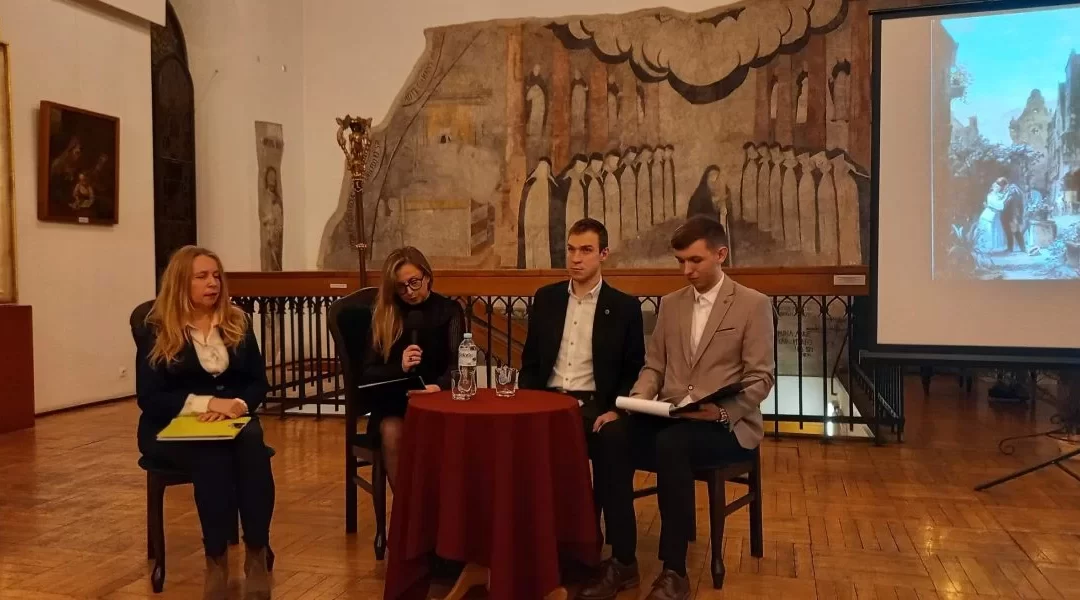
On that day, enthusiasts of local history gathered at the Racibórz Museum to attend the scientific conference entitled “From the History of the Napoleonic Wars in Silesia, Racibórz and the Surrounding Area”. As part of the conference, chaired by Renata Sput, PhD and Piotr Sput, PhD, President of the Society of Friends of the Racibórz Region and several German philology students from the University of Applied Sciences in Racibórz – Ms Iwona Kurzidem and Mr Kamil Wieczorek and Mr Adam Matuszek, an extensive multimedia presentation and several lectures were delivered, relating to the early period of the Napoleonic era in Silesia.
The lectures discussed the causes of the Prussian-French war in 1806, the entry of French and Bavarian troops in Silesia, the siege of the Koźle fortress at the beginning of 1807, the course of the Hit-and-run warfare conducted by Prussian units against the Napoleonic army and Polish insurgents operating in the eastern areas of Upper Silesia, as well as the tragic situation of the inhabitants of Racibórz, who were burdened with contributions and other demands of the occupying forces.
The later part of the meeting presented accounts preserved in the diary of Joseph von Eichendorff from that period. A third-year student, Ms Iwona Kurzidem, presented the figure and work of Eichendorff’s friend, architect and painter Carl Albert Eugen Schaeffer from Pszczyna in Upper Silesia.
Renata Sput, PhD discussed reports published in the only preserved Upper Silesian newspaper from that period, the “Oberschlesischer Anzeiger”, issued in Racibórz on 17 January 1807. The several-page report concerned the Prussian-French war, the situation in Silesia and mainly the fighting of Polish insurgents troops, who attempted to occupy the eastern part of Upper Silesia, including Gliwice as well as the remnants of Prussian cavalry under the command of Lieutenant Andreas Witowski.
The lectures and presentation were warmly received by the large audience. Particular interest was aroused by a member of a historical reenactment group from Adamowice, who attended the lecture dressed in a Napoleonic-era military uniform.
Text by Renata Sput