For over 20 years, the so-called Silesian House (Haus Schlesien) in Königswinter near Bonn has hosted “Silesian Meetings” – week-long historical workshops, to which students of German and other philologies from academic centres in Poland and the Czech Republic are invited. Haus Schlesien is a meeting place of the Association of Lower and Upper Silesians, where many political, cultural, social and historical projects are organised, including conferences, meetings and vernissages. The aim of these meetings, which are financed in 90% by funds from the German Federal Ministry of the Interior, is to familiarise young Poles with the history, present day, social life and political, economic, cultural and social system of contemporary Germany, also through the prism of the history of Silesia. For centuries, Silesia was a region where various national, religious, ethnic and cultural communities coexisted. It should be emphasized that the visits are always very well prepared.
This year was no exception.
From 7 to 13 December 2025, a group of students of German and English philology from the University of Applied Sciences in Racibórz, together with pupils from the Vocational and Continuing Education Centre No. 2 “Mechanik” in Racibórz, stayed in Königswinter, Germany. The visit, which has become a tradition, was of a scientific and educational nature. The participants not only visited many places worth seeing but also took part in lectures, presentations and historical meetings. They also prepared their own papers and multimedia presentations.
As in previous years, students and pupils were accommodated at the previously mentioned Silesian House (Haus Schlesien).
Four things deserve special attention. First, visits by students of the University of Applied Sciences in Racibórz to Haus Schlesien are cyclical, and the cooperation has been ongoing for a quarter of a century. Second, the visit was very well prepared, down to the last detail, with tourism and leisure integrated into scientific and educational tasks.
Importantly, the overwhelming majority of costs, amounting to several thousand Polish zlotys per person (including travel, accommodation, meals and entrance fees to many cultural institutions) were covered by funds from the German Federal Ministry of the Interior.
Fourth, this was yet another joint trip of students and pupils to the event, organized as part of the cooperation between the University of Applied Sciences in Racibórz and the Vocational and Continuing Education Centre No. 2 “Mechanik”. It is worth emphasising that trips to Königswinter have become a permanent element of cooperation between the two institutions.
After arrival on Sunday, students and pupils were introduced to the seminar program and the topics of the lectures and presentations in which they were to participate. They also received topics for presentations, which they had to prepare independently over the course of the week.
The topics covered a wide range of issues related to the thousand-year long history of Silesia, notable Silesians, Polish-German relations in the past and present, expulsions and migrations after World War II, the current situation and prospects of the European Union and the contemporary geopolitical situation. To prepare their work, participants were given access to the extensive library and archives of Haus Schlesien.
On Monday, the participants travelled to Düsseldorf. There, in several groups, they toured the old town and Rhine promenades, while some searched for traces of Heinrich Heine. Students and pupils also visited the seat of the Parliament of the federal state of North Rhine-Westphalia in Düsseldorf, where they met many interesting people, including the former Minister-President of North Rhine-Westphalia, Armin Laschet.
On Tuesday, participants explored Haus Schlesien, primarily its modern museum, as well as other exhibitions, the library and the archives. The work of the centre was presented to the group by Nicola Remig and Adam Wojtala. Participants also collected materials and iconography for their final presentations.
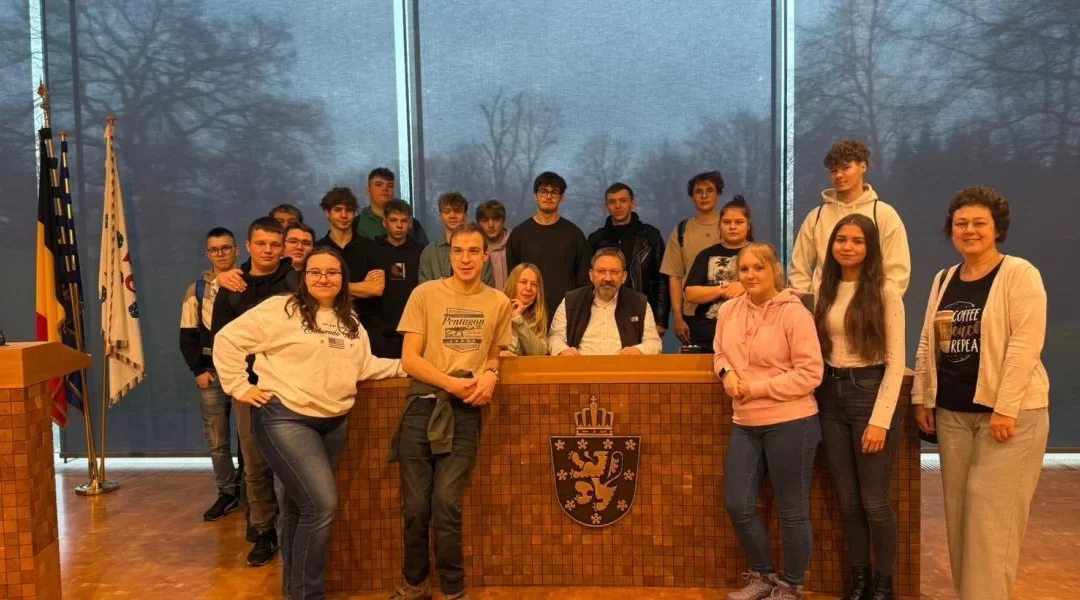
On Wednesday, the group spent the entire day on trips. In the morning, they visited the Eupen region in Belgium, where approximately 80,000 Belgians of German origin live within eight municipalities (Deutschsprachige Gemeinschaft). The German speaking community has its own regional parliament, budget and government which decide on many local matters. The group visited the parliament and learned about its activities, parliamentary work, local competencies and political parties operating in the region.
In the afternoon, the seminar participants visited Aachen, the first capital of Europe during the reign of Charlemagne. There, they toured Charlemagne’s famous palace and chapel, observed ancient Roman remains in the city’s architecture and explored the old town with omnipresent Christmas markets.
Thursday’s visit to Cologne and tour of the old town and famous cathedral was very interesting.
On Friday, in the final day of the seminar, students and pupils presented the results of their scientific work in the form of lectures and multimedia projects prepared on previously assigned topics.
The group was supervised by: Estera Jasita, PhD and Renata Sput, PhD from the University of Applied Sciences in Racibórz and Piotr Sput, PhD from the Vocational and Continuing Education Centre No. 2 “Mechanik”.
Text by Renata Sput